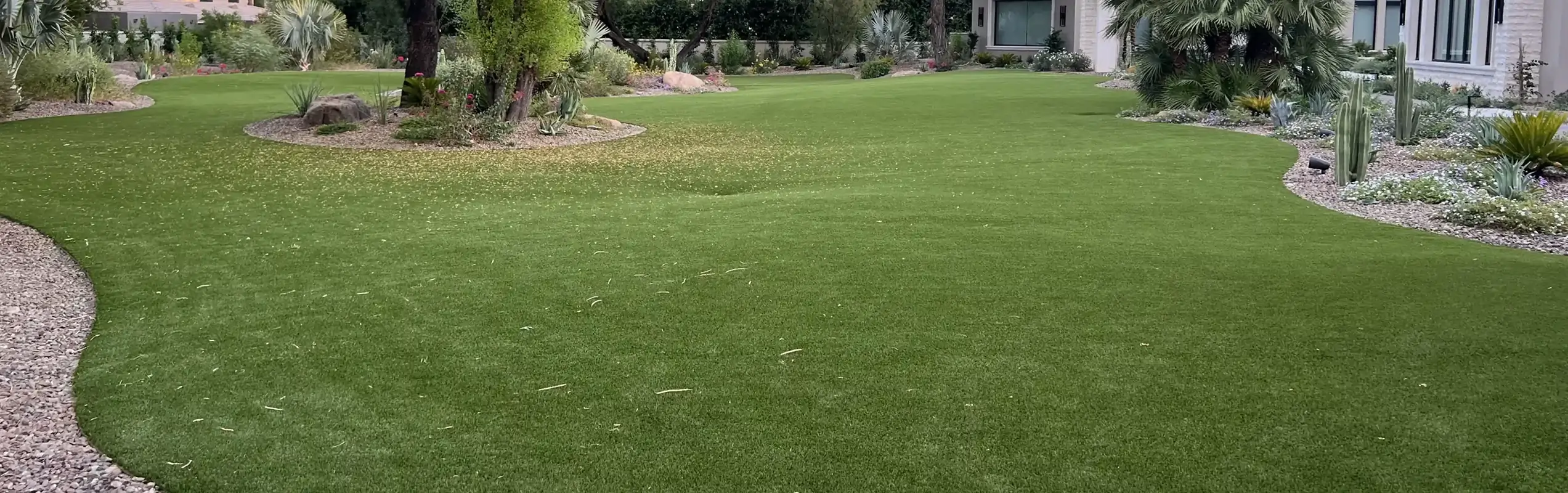
Fort Bend County commercial properties carry a distinctive character. The businesses that anchor Sienna's village centers, the office parks near Riverstone Boulevard, and the retail corridors along Highway 6 all see foot traffic that reflects one of the most diverse suburban populations in the United States. Clients, tenants, and visitors bring expectations shaped by cosmopolitan sensibilities — and exterior spaces that look tired, muddy, or patchy signal neglect in a market where that impression travels quickly.
Artificial Grass of Missouri City approaches commercial turf installation with that reality in mind. A well-executed turf surface at a business entrance, an HOA amenity lawn, or a multi-tenant building's common corridor reduces ongoing landscaping costs while keeping the exterior consistently presentable regardless of the season. Fort Bend summers are brutal, Brazos River moisture pushes through the bottomlands, and clay soils across Sienna and Riverstone drain unpredictably. Natural grass in those conditions demands constant irrigation, aeration, and recovery time after heavy use — none of which is practical in a commercial setting.
Our installation process for commercial sites begins with a thorough site assessment. We measure the full project area, identify drainage slopes and low points, note access constraints for equipment, and document any hardscape interfaces — entry plazas, pavement edges, loading areas, signage bases — where clean transitions matter most. Commercial clients in the Sugar Land Town Square corridor, Stafford's light industrial edge, and the mixed-use zones along Fort Bend Parkway have each brought distinct layout challenges that required customized planning rather than a copied template.
Base preparation is where commercial installations earn their longevity. We excavate to appropriate depth, install a geotextile fabric barrier to block weed intrusion, compact a crushed aggregate base that supports both load and drainage, and confirm slope grades before turf is ever unrolled. The turf itself is selected for commercial-grade fiber density and UV stabilization — necessary for a surface that faces the Texas sun twelve months a year without indoor recovery time. Seam placement is planned to fall in low-traffic zones where possible, edges are secured with bender board or nailed perimeter systems depending on the substrate, and infill is distributed evenly for uniform surface resilience. The finished surface is groomed and inspected before handover.